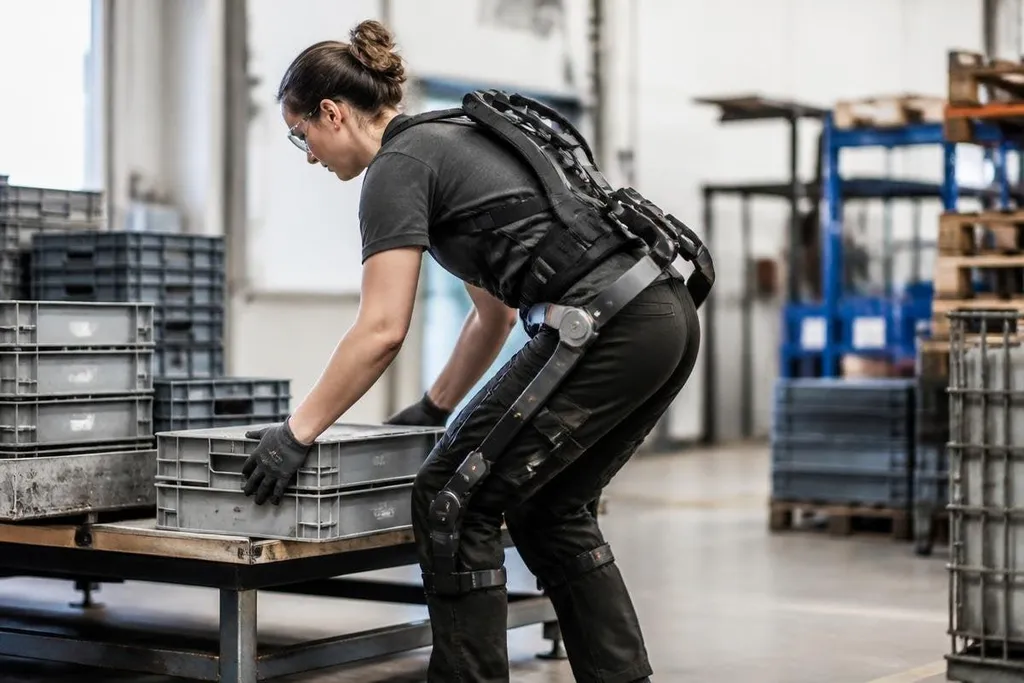
A robotic exoskeleton can reduce the effort needed to lift, walk, or hold a tool. The hard part is making that help arrive at the right moment, fit different bodies, and keep working through a full task.
- Powered joints add force at the hips, knees, or ankles
- Sensors must read movement without slowing it down
- A useful system needs a clear job, not a vague promise
Three designs, three jobs
A passive exoskeleton uses springs or other mechanical parts to store and return energy. It can be lighter and easier to maintain because it has no motors or battery, but its help stays tied to the way the frame was built.
A powered exoskeleton adds motors at one or more joints. Sensors read motion, force, or body position, then a controller sends commands to the motors. That system can change its support during a lift or a step, though the added hardware brings weight, charging, heat, and software faults.
Soft exosuits use fabric, cables, and small actuators around the body. They may fit more closely than a hard frame, but the system still has to transfer force through straps and clothing without causing pressure or slipping.
The right design depends on the task. A worker who holds a tool above shoulder height needs a different system from a patient relearning a walking pattern.
Control decides whether help arrives on time
Motor strength gets attention because it is easy to describe. Control timing matters more during use. If assistance starts too early, the robot can fight the wearer. If it starts too late, the wearer has already done the work.
That timing comes from sensors and software. A system may read joint angle, foot contact, muscle activity, or force in the frame. Each signal has a delay and a failure case, so the controller needs a safe response when data becomes noisy or disappears.
Fit adds another layer. Human joints do not rotate around fixed points in the same way as many machine joints. A hip or knee frame that sits in the wrong place can rub, restrict motion, or send force into the wrong part of the body.
A useful record names the exoskeleton, wearer, task, and test result. Robot24.com exoskeleton reporting can place those details beside claims about comfort and assistance. Then you can measure the task, not the video.
Measure the task, not the video
A product video can show a clean lift. It cannot answer every question about a shift, a clinic, or a changing work area. Ask for results tied to the task you need to support, then check how the test was run.
A useful trial should measure the work before and after the exoskeleton arrives. Record lifting rate, error rate, fatigue reports, setup time, and any pain or pressure caused by the frame.
Those results need context. A lower effort score means little if the worker cannot reach the shelf or walk between stations. Check battery time during the stated task, frame mass while the wearer bends or walks, and the body sizes that can use the frame without a new setup.
Where the limits remain
Power is still a trade. More motor force usually means larger motors, stronger frames, or a larger battery. Those parts add mass, and the wearer must carry that mass during every step.
The task can change faster than the software. Uneven floors, stairs, tight spaces, wet clothing, gloves, and loads with different shapes all affect how a person moves. A controller tuned for one lift may behave poorly during another.
Safety also needs more than a stop button. The machine must limit force, detect faults, release support when needed, and let the wearer move away from danger. Training and supervision still matter because the exoskeleton sits between a person and the work.
A practical buying check
Use this checklist before a pilot or purchase:
- Define one task and record its current time, load, and error rate.
- Ask the maker for test conditions, including floor type and duty cycle.
- Check the frame on every body size that will use it.
- Run a short trial before testing a full shift.
- Measure setup, charging, cleaning, and service work beside task output.
- Set a stop rule for pain, loss of balance, sensor faults, or missed work targets.
The better exoskeleton will be the one that helps with a named task and keeps its limits visible. I'd treat motor strength as a specification, not a reason to buy, until a maker shows repeatable results in the work that matters.